
Somewhere in your closet is a pair of jeans you call “the good ones,” even though you adjust the waistband when you sit, dislike every shoe you wear with them, and remove them the moment you get home.
Those are not your good jeans. They have simply defeated the other jeans in a competition nobody enjoyed.
A useful denim drawer does not need to contain every fit the internet has rediscovered since Tuesday. It needs enough range to support the clothes you actually wear. That might include one clean dark pair, one relaxed everyday wash, and one silhouette with a little more personality. The precise number is less important than whether each pair has a job and performs it without emotional supervision.
Begin with evidence, not aspiration.
Take every pair out and place them where you can see them. This is not a folding tutorial. We are establishing which jeans belong to your real wardrobe and which have been retained by a fictional man who may someday attend a fictional event at a fictional weight.
For each pair, ask when you last wore it for more than an hour. Then ask what you wore with it. If you cannot remember either answer, the jeans are not currently part of your wardrobe. That does not automatically mean they must go, but it moves the burden of proof firmly onto the denim.
Fit starts at the waist and seat.
The waistband should remain in place without requiring a belt to perform structural engineering. A belt can finish an outfit or make a small adjustment; it should not be gathering several inches of denim into an emergency pleat.
Sit down. The waistband should not dig sharply into your stomach, while the back should offer enough coverage that you are not forced to choose between breathing and remaining dressed. Stand and look at the seat. Large folds beneath it can signal excess room or the wrong cut; tight horizontal pulling can signal that the fabric is under strain.
None of this requires chasing one supposedly perfect fit. Bodies differ. Denim differs. Some stretch relaxes dramatically; rigid denim changes more slowly. The useful question is whether the pair feels secure, moves with you, and produces the silhouette you intended.
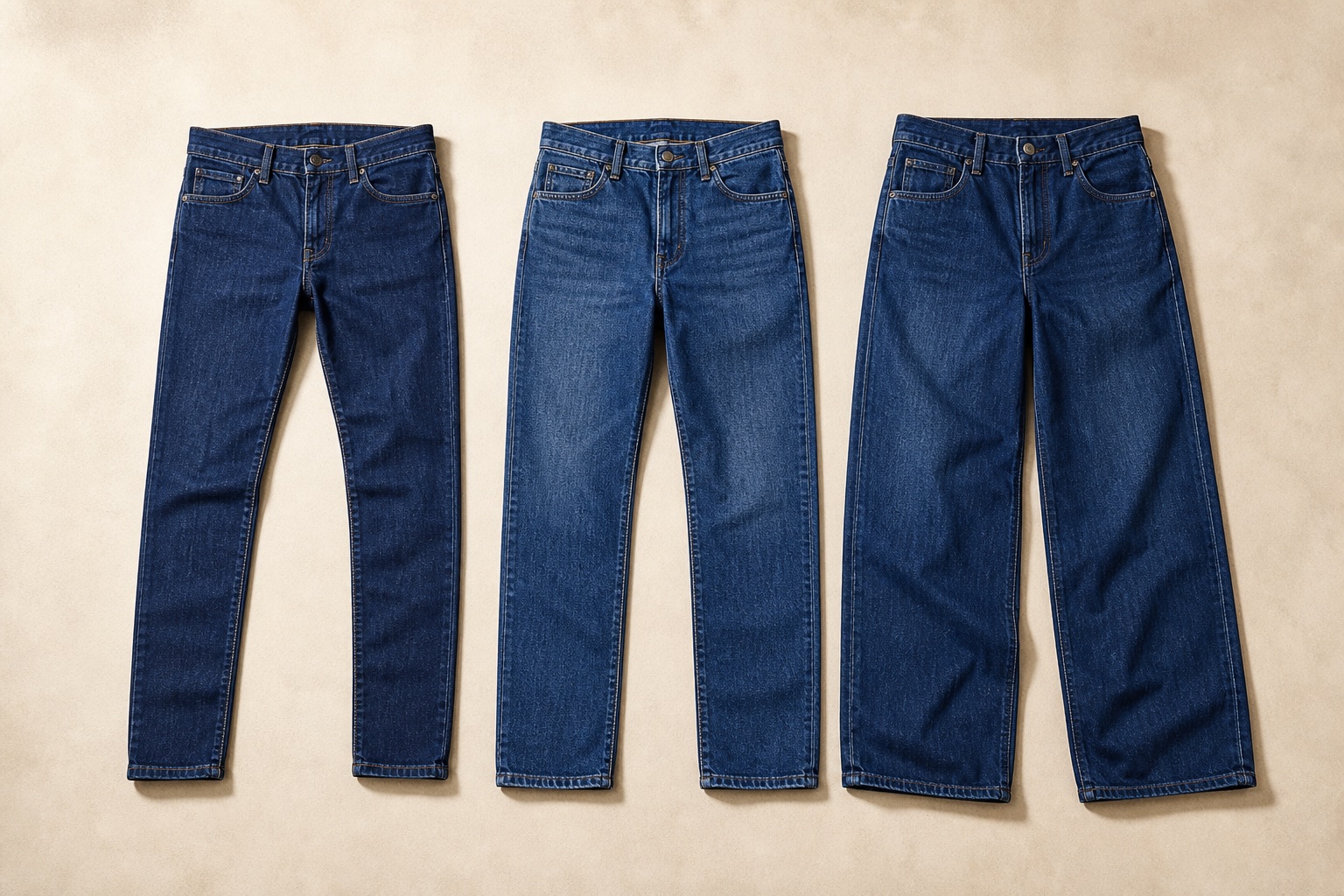
The leg shape has to cooperate with your wardrobe.
A tapered jean narrows toward the ankle and can work neatly with lower-profile shoes and closer-fitting jackets. A straight jean carries a more consistent line from thigh to hem and tends to cooperate with almost everything. A relaxed or wide jean creates more volume and often looks strongest with a substantial shoe and enough shape above the waist to balance it.
No silhouette receives permanent custody of good taste. The question is whether the shape helps you build outfits with the clothes you own. If one pair only works with one shoe, one jacket, and a precise atmospheric pressure, it may be a special-purpose jean. That is allowed. It just cannot pretend to be your dependable everyday pair.
Condition is not the same as character.
Denim improves through wear when the fading follows your movement and the fabric remains sound. It stops being charming when the inner thighs are one commute from a diplomatic incident, the pocket is detaching, or the hem is absorbing the pavement.
Minor damage can often be repaired. A skilled alteration or denim-repair shop may reinforce thinning fabric, repair a pocket, or correct the length. But repairs should preserve a pair you genuinely value. They should not fund an elaborate restoration of jeans you already avoid.
The Closet Audit
Keep. Tailor. Replace. Release.
Keep
You reach for them, they fit the life you have, and the fabric is sound.
Tailor
The waist and seat work; the length or leg needs a professional correction.
Replace
The role matters, but this pair is uncomfortable, damaged, or fighting your current wardrobe.
Release
They do not fit, suit, or serve you. No imaginary future version of you has requested them.
Tailoring has limits.
Length is the easiest problem to understand. A clean hem can transform jeans that stack awkwardly over every shoe. A modest waist adjustment may also be possible, depending on the construction and how much needs to change.
Changing the entire rise, seat, thigh, and leg shape is a different proposition. Once the alteration attempts to redesign the jeans, replacement may be more sensible. Ask a tailor what the adjustment will change elsewhere in the garment and compare the cost with finding a cut that begins closer to your needs.
BlossipBoy verdict
Keep fewer. Demand more.
Your best jeans should fit without a negotiation, connect easily to the rest of your wardrobe, and survive an ordinary day without becoming the main event.
The final try-on
- Wear each contender with the shoes you reach for most.
- Try the shirt or knit both tucked and untucked.
- Add your usual jacket and check whether the proportions still agree.
- Sit, walk, bend, and use the pockets.
- Take a photograph from several feet away.
- Notice which pair lets you think about the outfit. Notice which makes you think only about the jeans.
The winner is not necessarily the newest, darkest, widest, or most expensive pair. It is the one that makes getting dressed feel like less of a committee meeting.
Those are your good jeans. The others may collect their things.